The Digital & Media Summit in the Sonar+D

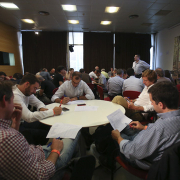
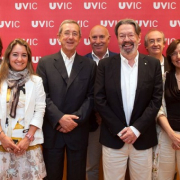
This year’s edition of Sonar+D festival hosted the Digital & Media Summit workshop, co-organized by Ecommerce&tech Barcelona and the Catalan Audio-Visual Cluster, with the participation of representatives from 30 national companies in the technological and audio-visual industries.

The participants shared their experiences and explored new ways of forming partnerships and trade agreements. The meeting helped to confirm that audiovisual and digital businesses are increasingly connected and can easily create complementary partnerships and new business models. The growing demand for audiovisual content for all kinds of devices, the digital companies’ knowledge about their user base, and the direct monetization of content and services have been the most valued topics for the representatives of both industries.

The two-hour workshop allowed the participants to establish new contacts and collaborations thatare continuing beyond the Digital & Media Summit.

Indy Saha, From the Google Creative Lab, Talks about Strategy, Innovation and Creativity in the Digital World

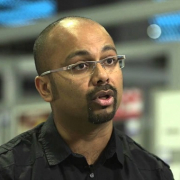
On May 29th in Barcelona the Catalan Audio-Visual Cluster, in collaboration with the Royal Melbourne Institute of Technology (RMIT University), organized the session “Strategy, innovation, and creativity in a rapidly changing digital world” in which Indy Saha, director of strategy of Google Creative Lab, participated as a speaker.

During his talk, Saha presented the Google Creative Lab, an interdisciplinary team based in London, but with several working groups scattered between different cities, such as New York, San Francisco and Sydney. Its main goal is to create pilots and prototypes for new products and services linked to the internet, as well as to promote the use of the Net for the development of new creative and educational projects.

For example, Saha presented “DEV.ART Art made with code”, a platform created by Google that hosts several artistic projects based on the use of data; the Google Science Fair, created as on online platform to encourage young people to improve their scientific and innovation skills; or the Hangout Comedy Club, which transforms YouTube into a platform for humor-based content.

He also referred to Spell Up for Google Chrome, which provides educational tools for English-learners; or the Science Museum/Web Lab and the Google Chrome Web Lab, two interconnected projects that allow the user to interact via the Internet with the contents of the Science Museum.

Lastly, Saha reflected on the need to produce new work dynamics based on collaboration between people and companies, research, multi-disciplinarity and trans-disciplinarity. He celebrated the existence of the Catalan Audio-Visual Cluster, while encouraging the companies involved in the Cluster to apply new ways of working that prioritize innovation and creativity, one of the keys to Google’s success.

The Cluster Warns That Closure of CMMA’s Channels Will Cause a Decline in the Sector

The Catalan Audio-Visual Cluster denounces the possible closure of the Catalan Broadcasting Corporation (CCMA) channels that may follow the restructuring of the radioelectric domain by the central government.  This measure would have a negative impact on the Catalan audio-visual sector, which is already strongly affected by the economic crisis.

The Cluster points out that several TV channels from around the country have closed over the last few years. This, along with the economic difficulties that the country faces, causes the accelerated decline of the audio-visual sector, resulting in the closure of companies, loss of jobs and brain drain. If this trend continues, the audio-visual sector could quickly face a scenario similar to that of twenty years ago: a great concentration of channels and a weak industrial fabric.

It also states that the reduction in the number of channels or the decrease in the availability of high definition pushes the Catalan sector away from the market and the European standards.

The Catalan Audio-Visual Cluster remarks that the restructuring of the radioelectric domain is a technical matter and there are several alternative solutions which can be examined when there is a strong spirit of dialogue and collaboration. Due to the current situation faced by the audio-visual industry, the Catalan Audio-Visual Cluster asks the public authorities to create a technical commission where the sector could develop new solutions for the future.

Rod Perth, President of NATPE, Meets With the Catalan Audio-visual Industry

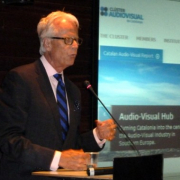
The viability of establishing cooperation pathways with Barcelona and the possibility of exploring new business opportunities related to its audio-visual content were one of the ideas exposed by the president of the National Association of Television Program Executives (NATPE), Rod Perth, during his lecture organized by the Catalan Audio-visual Cluster in the headquarters of Barcelona Activa. Barcelona’s capacity and prestige and its commitment to the digital world, mobility and new business, ensured Perth, are the keys elements of the future collaboration.

NATPE, held in Miami each January, is one of the world’s most important events around the issue of content markets. As Rod Perth explained, the goal of NATPE is to maintain a business model based on personal and direct contacts, bringing together the major actors of the audio-visual industry, and that stresses transformation and adaptation to changes in the market and consumer habits.

The industry, concluded Perth, is changing due to digital technologies, and content forms the transversal basis for this transformation. “For this reason, the audio-visual world needs to find new, fresher and more innovative ways to open up new markets and to establish new relationships between buyers and sellers”.

Rod Perth’s visit to Barcelona also included meeting with Fira de Barcelona, Turisme de Barcelona, and a meeting at Foment del Treball with the representatives of the Catalan business world.

The Catalan Audio-visual Cluster Signs a Collaboration Framework Agreement With Telecos.cat

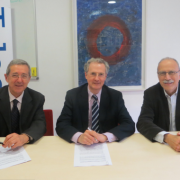
The president of the Catalan Association of Telecommunication Engineers (Telecos.cat), Joan Solé, and the president of the Catalan Audio-visual Cluster, Xavier Guitart, signed a collaboration framework agreement by which both institutions commit to work together in support of the audio-visual sector.

Consequently, the Acoustic and Audio-visual working group of Telecos.cat include a Cluster representative who will contribute to the development of the activities of the collective, such as the organization of conferences, seminars, courses and sessions, that serve to disseminate subjects related to this sector.

Moreover, Telecos.cat commits to collaborate with the Cluster to facilitate and promote the cooperation between the agents of the audio-visual sector and the TIC sector, to ultimately strengthen innovation, creativity and talent, and to position Catalonia as a recognized worldwide audio-visual center.

Finally, the agreement promotes the organization of joint events in the aforementioned fields.

Jaume Codina, representative of the Committee of Telecos.cat in the Acoustic and Audio-visual working group was also present at the signing.

The CAC and the Catalan Audio-visual Cluster Will Promote the Creation of Points of Commonality for Agents of the Sector

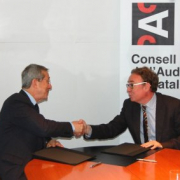
The president of the Catalan Audio-visual Council (CAC), Roger Loppacher, and the president of the Catalan Audio-visual Cluster, Xavier Guitart, have signed a collaboration framework agreement between these two institutions. The signing event was held at the CAC’s headquarters.

The framework agreement stimulates the collaboration between both parties to increase the promotion, knowledge, dissemination, and strength of the Catalan audio-visual sector, as well as the promotion of mechanisms to guarantee the rights of users and the protection of minors.

Specifically, this agreement states that both organizations will cooperate in order to create and strengthen dialogue and commonalities between public and private DTT and FM communications service providers, telecommunication operators, providers of new communication services, audio-visual content production companies, technology companies and companies developing mobile applications.

Moreover, this agreement stipulates that both the CAC and the Cluster will work together on projects, research and vitalization activities related to the audio-visual sector. Especially, it will promote research and awareness of new audio-visual communication services, new screens and new business models.

The CAC will also invite the Cluster members to participate in the Forum of Communication of Catalonia and in roundtable discussions hosted by the CAC to debate about subjects concerning the audio-visual field and sector regulation.

The UPF and the Catalan Audio-visual Cluster Will Collaborate in the Communication, TIC and Culture fields

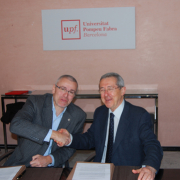
The Pompeu Fabra University and the Catalan Audio-visual Cluster have signed a collaboration framework agreement by virtue of which both institutions will work together to promote training, dissemination, innovation and research in the audio-visual, communication technologies and cultural fields.

Jaume Casals, rector of UPF, and Xavier Guitart, president of the Catalan Audio-Visual Cluster, signed the agreement, which has a timeframe of two years (extendable) and takes into account that the scope of collaboration will be progressively updated by means of action programs regulated through specific framework agreements.

Present at the signing event were Xavier Binefa, director of the Department of Information and Communication Technologies (DTIC); Xavier Ruiz Collantes, dean of the Communication Faculty; Enric Reig, director of ESUP; Josep Blat, professor of DTIC and Josep Gifreu, emeritus professor of UPF (on behalf of the director of the Communication Department). Representing the Cluster were Jaume Pujol, Joan Rosés and Miriam Mendoza.

The Sector’s Principle Companies Come Together in the Catalan Audio-Visual Cluster to Generate Wealth

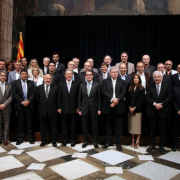
The Catalan Audio-Visual Cluster was presented this afternoon at the Palau de la Generalitat, during an event presided over by Artur Mas. This association has been promoted by several economic and industrial organizations and it brings together, for the first time, companies from the entire audio-visual production and distribution chain; as producers, distributors, exhibitors, radio and television operators, telecommunication operators and technological and service companies.

The Cluster is made up of around 50 promoting companies and its main goal is to strengthen the Catalan audio-visual sector so that it becomes one of the strategic industrial, economic and cultural sectors of the country for wealth generation. According to 2010 figures, the Catalan audio-visual sector invoices 1.700 millions of euros per year and employs 10.200 people, being one of the few sectors that creates jobs for those under 30 years of age. Therefore, the Cluster seeks to encourage competitiveness, efficiency and innovation, to create new opportunities and attract new investments, and turn Catalonia into an international reference point through the promotion of its new status as an industrial and cultural capital related to the audiovisual sector in the south of Europe.

The Cluster, with the support of the Generalitat de Catalunya, intends to be of service to all those companies and professionals that, in one way or another, could benefit from the growth in activity of an industry that mobilizes creative people, operators, technicians, service professionals as well as research and development of academic disciplines from the university world. The idea is to maximize the monetization of the resources and capacity of the collaborating institutions in order to reduce costs, produce synergies and work with maximum efficiency and unity to boost the industry.

The Cluster’s president will be Xavier Guitart i Domènech.