The Catalan Audiovisual Cluster, with the support of ACCIÓ, the Catalan Government’s agency for business competitiveness, organized a business mission to South Korea focused on inspiration and learning. This Asian country has turned its audiovisual and music industries into a driver of international growth, fueled by the global wave of K-pop and Oscar-winning film productions. The aim of the mission was to analyze one of the world’s most advanced audiovisual ecosystems, explore cutting-edge audiovisual technologies, understand how the Korean industry is evolving, and bring this strategic perspective to the future of the Catalan ecosystem, without an immediate commercial objective.
From April 14 to 17, a delegation of around fifteen representatives from Catalan companies and institutions traveled to Seoul, accompanied by representatives from ACCIÓ—both from Catalonia and South Korea—as well as the president of the Catalan Audiovisual Cluster, Miquel Rutllant, and the Cluster Manager of the Catalan Audiovisual Cluster.
“This mission aims to analyze and understand where the audiovisual industry is heading on a global scale. South Korea is currently one of the best examples of how content, technology and industry can be connected to generate international impact. We have come to observe, listen and learn how this model is built, in order to rethink—through this lens—the future of the Catalan audiovisual sector,” said Miquel Rutllant, president of the Catalan Audiovisual Cluster.
South Korea, a benchmark in new formats and content models
South Korea has established itself as one of the leading global references in content creation and export, driven by the so-called hallyu, or Korean cultural wave, which has placed K-pop, television series and cinema at the heart of global culture. This leadership has been particularly evident with the international success of productions such as Parasite, which won the Academy Award for Best Picture in 2020, and more recently K-Pop Demon Hunters, also awarded two Oscars. In the music industry, global K-pop phenomena such as BTS and BLACKPINK have redefined the relationship between content, fans and digital platforms, turning K-pop into a worldwide industry with significant impact. In the case of BTS, their return to the stage with a new world tour across 34 cities spanning all five continents is a clear example of this global reach.
This phenomenon also has a direct connection with Catalonia. Series such as The Legend of the Blue Sea, with scenes shot in Barcelona, Sitges, Girona and Tossa de Mar, have helped position Catalonia as a tourist destination among Korean audiences.
At the same time, the growing presence of Korean culture is reflected in initiatives such as the Korean Film Festival Barcelona, as well as the participation of Korean artists at the Primavera Sound festival (with acts such as Dreamcatcher and Balming Tiger), and the presence of Arts Korea Lab in cultural innovation spaces.
The success of K-Contents reflects a diversified and expanding audiovisual sector that goes beyond video games, encompassing broadcasting, film and webtoons, with an economic impact in 2024 exceeding USD 3.5 billion in exports. IPs, or intellectual property, refer to the rights over an original creation (such as a story, characters or narrative universe) that can be exploited and adapted across different formats (series, films, video games, books, etc.). This model combines public support, private investment and AI-driven technology, and consolidates South Korea as a global benchmark in new formats, business models and content–audience engagement, with an ecosystem capable of constant adaptation, innovation and expansion.
“What we are particularly interested in about South Korea is its ability to export the hallyu model of Korean culture and build an ecosystem where technological innovation, creativity and IP development work in an integrated way. Understanding how they have reached this point allows us to identify opportunities to strengthen the competitiveness of our sector and adapt to an increasingly global and interconnected context,” says Eduard Gil, Cluster Manager of the Catalan Audiovisual Cluster..
Catalonia–Korea connections and the Korean National University of Arts
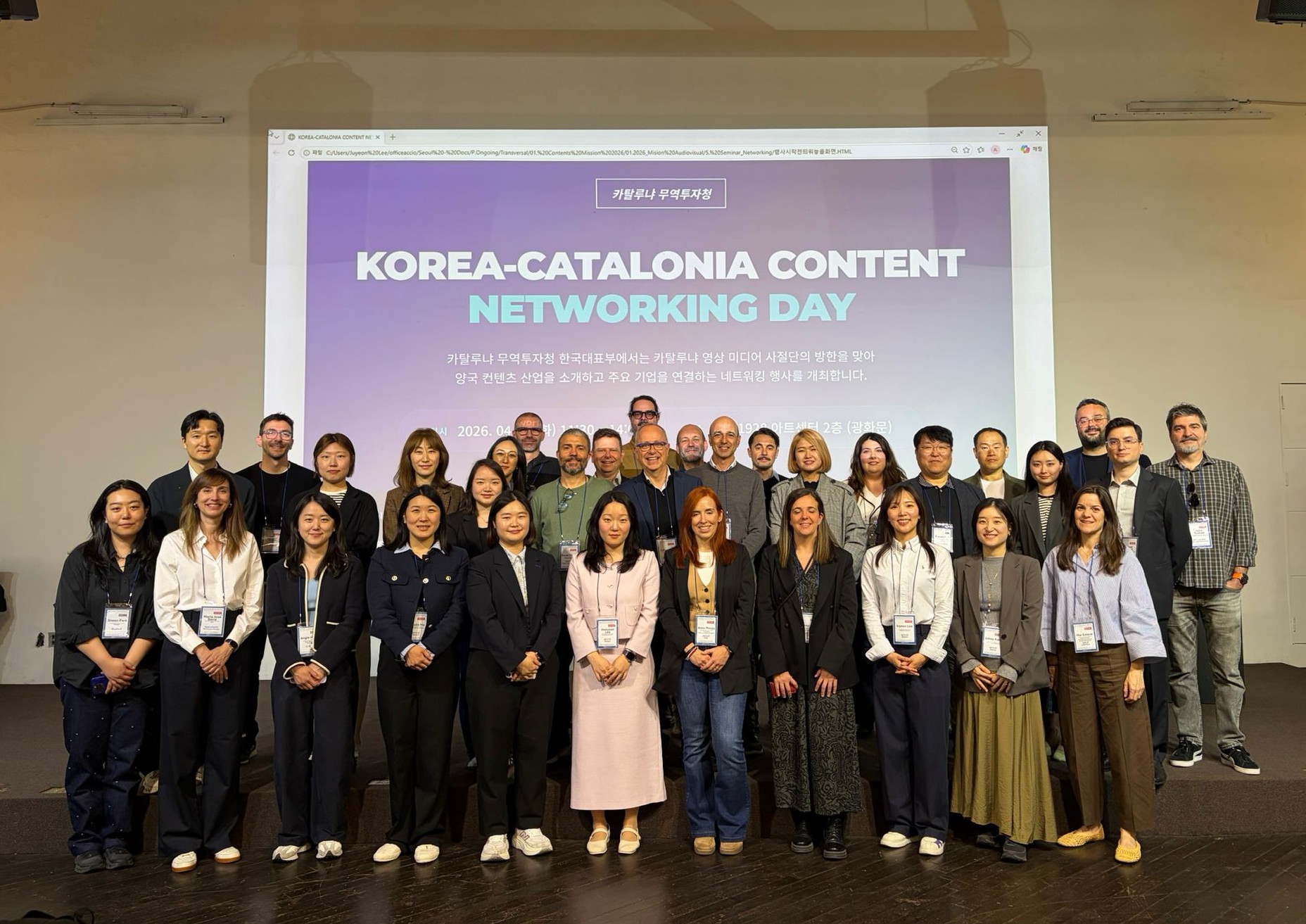
The first day, focused on contextualizing the Korean audiovisual industry, included a seminar led by the Korea Creative Content Agency (KOCCA), the equivalent of ACCIÓ in South Korea. The session addressed the creation of K-Contents, its main sectors (audiovisual, video games and web content), as well as its economic impact and its evolution with artificial intelligence. Following this introduction, ACCIÓ, the Clúster Audiovisual de Catalunya and the Catalunya Media City project were presented, along with the different Catalan companies in attendance. The day continued with networking sessions designed to share experiences, establish contacts and create a framework for dialogue and collaboration between Korea and Catalonia.
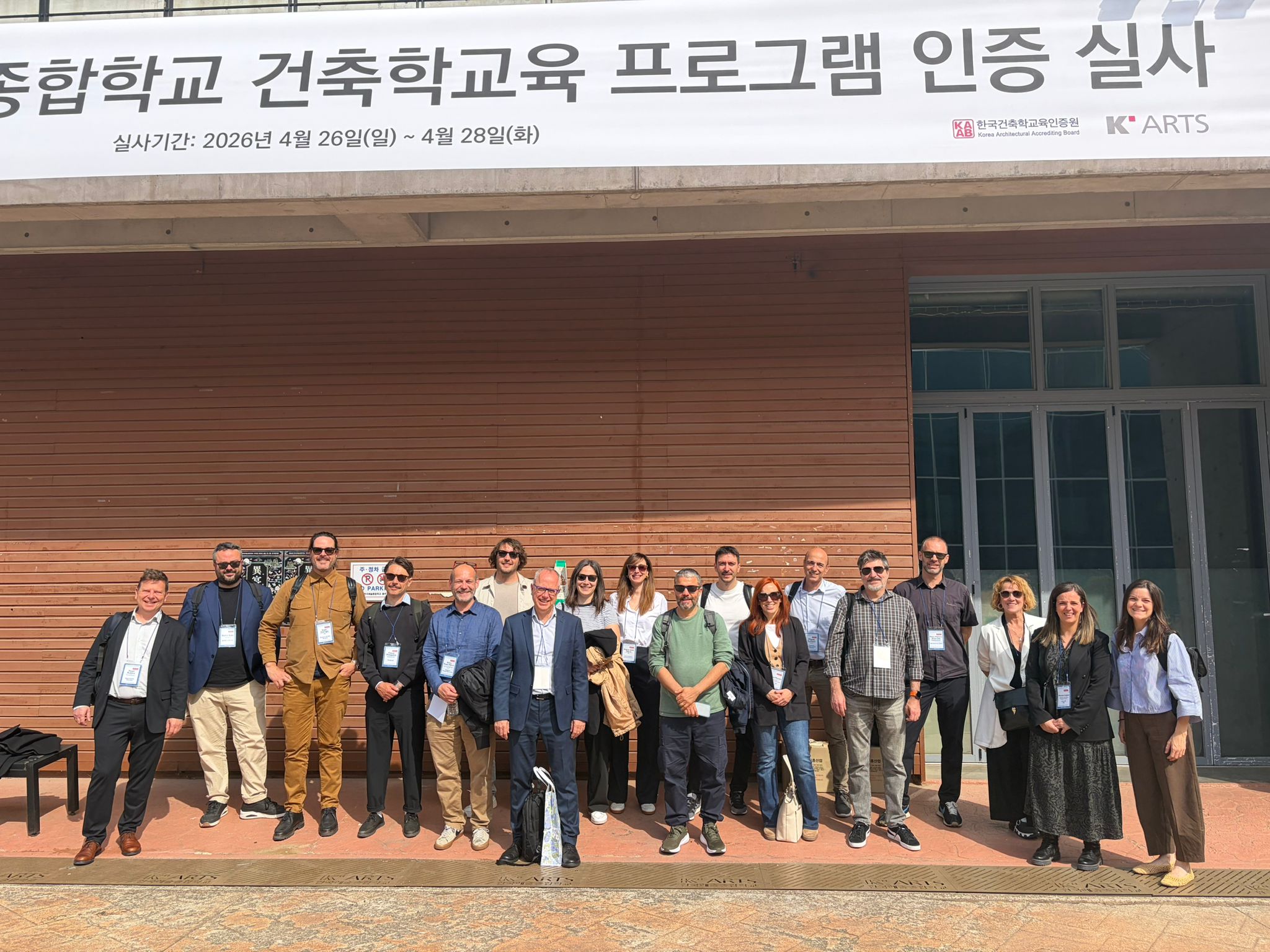
Later, the delegation visited the Korean National University of Arts, focused on the convergence of technology, art and education. They engaged with the K-Arts School of Film and its Art & Technology Lab. There, they discussed AI and production with Seungmoo Lee, Head of the University Research Institute, and Seungpyo Kang, Chief Operating Officer. They also toured the facilities and gained insight into several of its key projects.
K-drama studios, AI, virtual production, VFX and immersive technologies
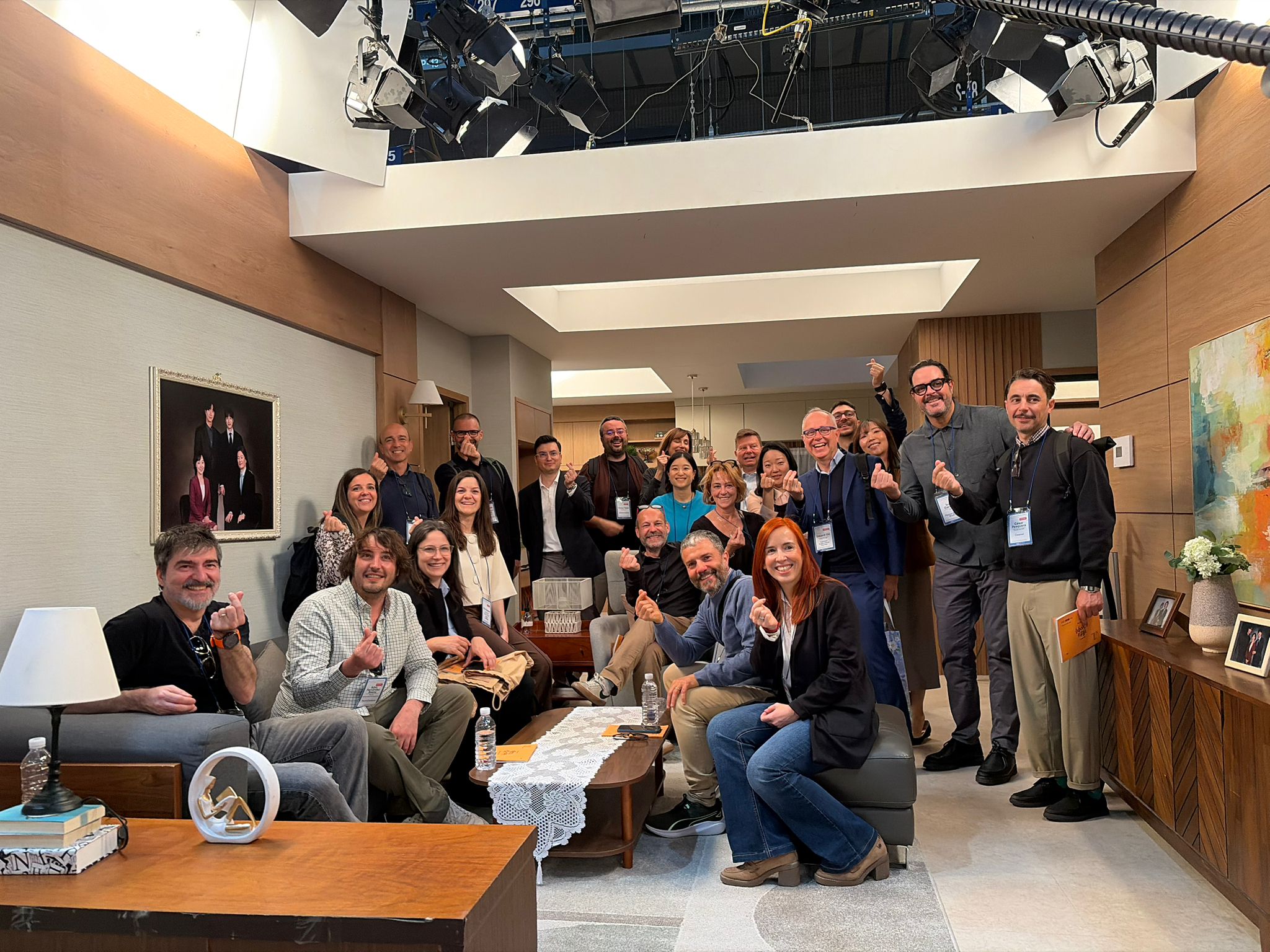
During the second day of the mission, activities focused on technology and AI applied to audiovisual production, with visits to MBC C&I, one of South Korea’s leading public broadcasting companies (responsible for formats such as Mask Singer). There, the delegation explored the AI Content Lab and discovered how artificial intelligence is being applied end-to-end in audiovisual content production, including a full-length film created with AI. They also toured its studios and experienced first-hand how a K-drama is produced in real time.
The next stop was CJ 4DX, a subsidiary of the CJ Group that develops immersive cinema technologies. There, they experienced a 4D screening at one of the leading companies in this field. Finally, they visited Dexter Studios, specialists in visual effects, virtual production and immersive content, and creators of the Along with the Gods saga, as well as the company responsible for the visual effects in films such as Parasite and Train to Busan.
Intellectual property, animation and digital production
Intellectual property (IP) and hands-on audiovisual content creation were the main focus of the visit to NC AI / NCSoft, centered on the development of advanced artificial intelligence technologies. The delegation was introduced to the company as well as its AI-based solutions and tools applicable to the media content industry, with a particular focus on video game production. Its offering is primarily built around its AI platform, VARCO, which integrates text, image, voice, video and 3D content generation to automate and accelerate digital content creation.
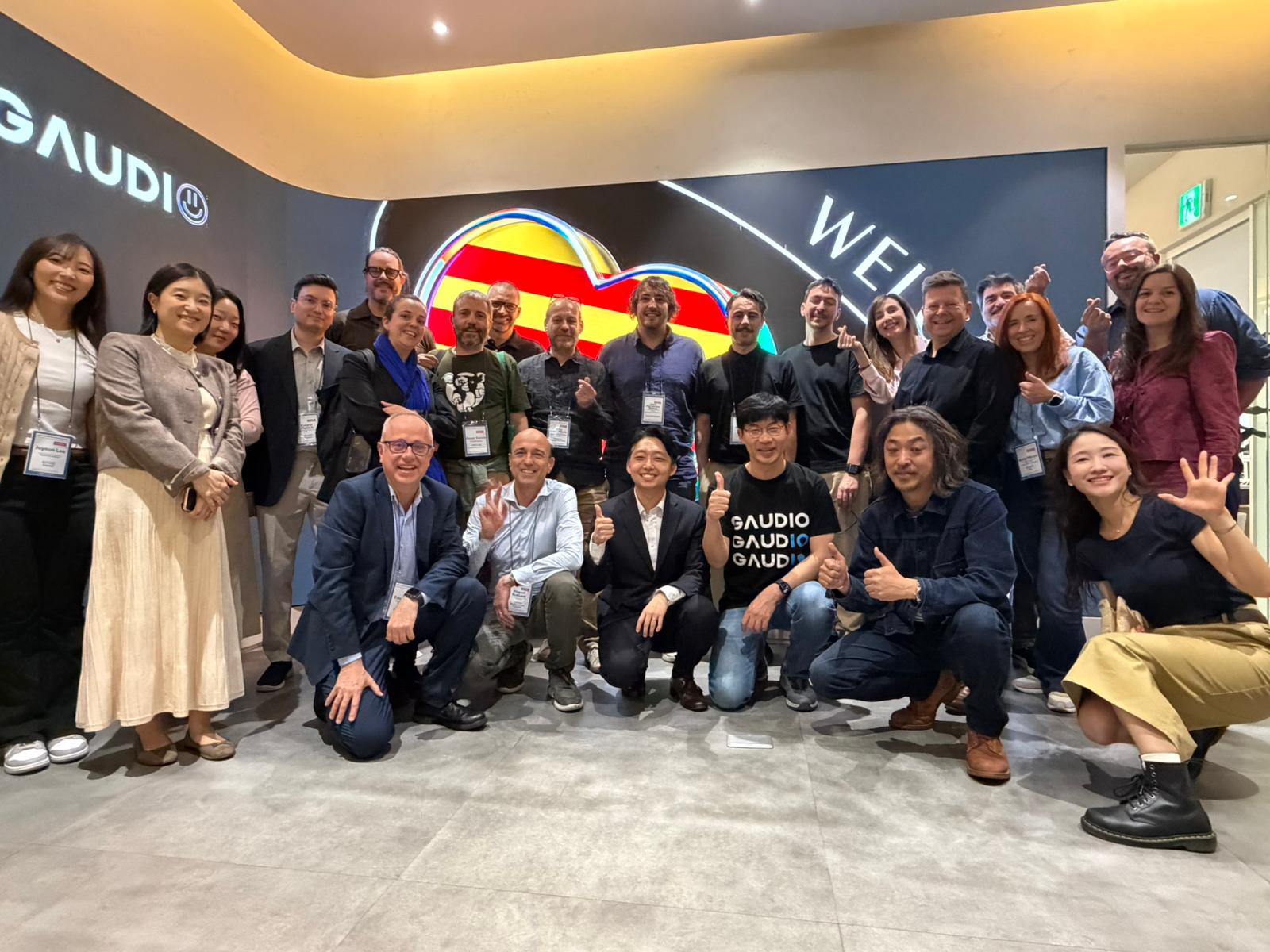
After visiting the surroundings of Seoul Tech City, the delegation went on to Gaudio Lab, a sound studio named after Antoni Gaudí. There, they explored its AI-powered audio tools and sound processing technologies, applicable to the media, video game and broadcasting sectors.
Finally, they visited MofacStudios, one of Asia’s most renowned VFX and animation studios, specializing in visual effects, animation and digital production, with titles such as King of Kings. The team presented different AI-integrated solutions for animation production and their global strategy for animation IP. The delegation also toured the facilities, including a VR motion capture studio.
Technology at the service of content
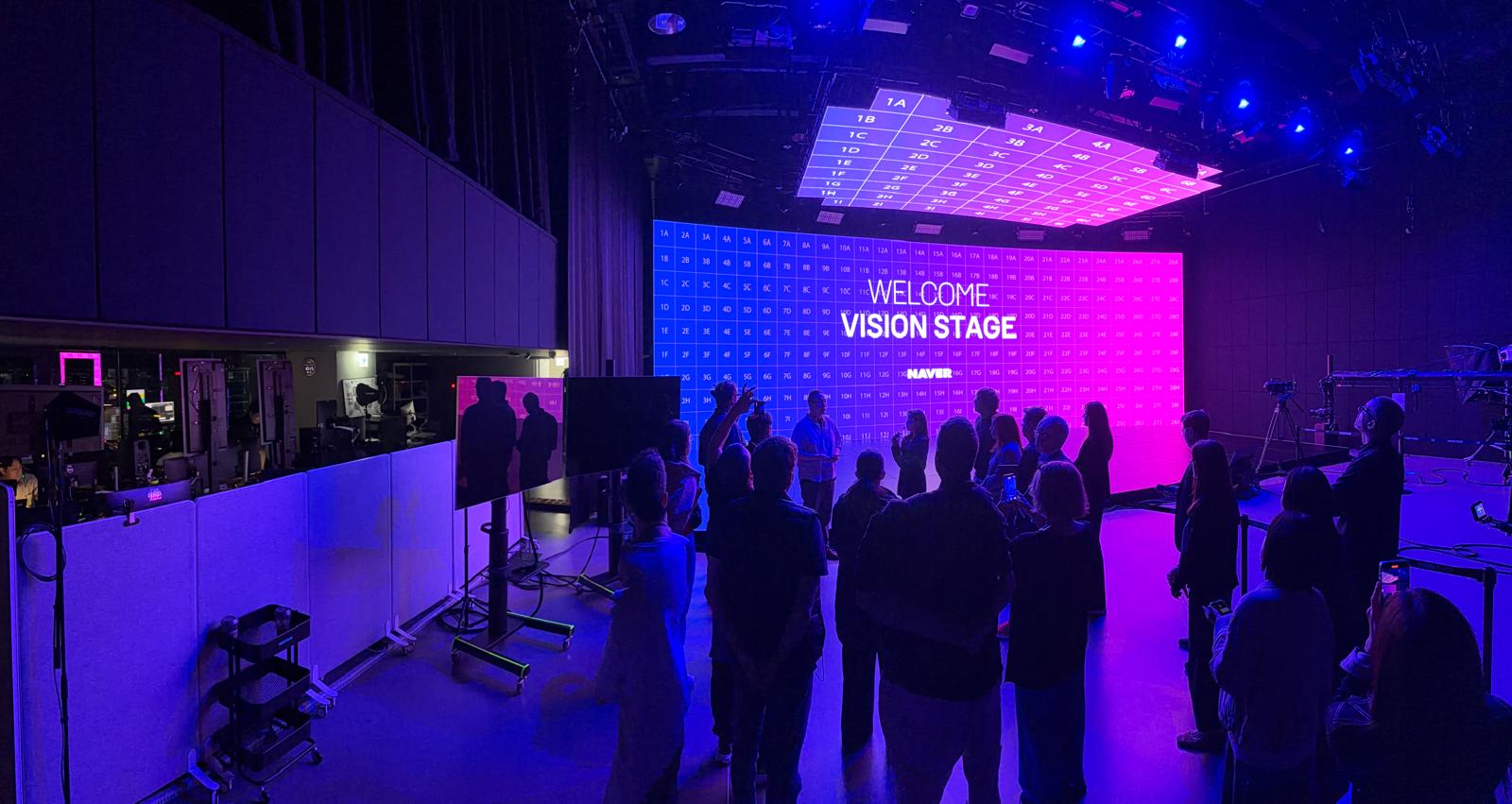
The final day had a more exploratory focus, with visits to innovative startups and studios such as Naver, one of South Korea’s leading technology companies, comparable in scale and impact to Google but with its own ecosystem widely integrated across areas such as search, research, content, payments and AI. The delegation visited the Naver Immersive Studio and explored how the company integrates advanced technology and artificial intelligence into digital services and audiovisual content.
This mission is part of the Catalan Audiovisual Cluster’s strategy to strengthen the international projection of the Catalan audiovisual sector, with the aim of learning from global benchmarks and bringing this experience back to support the development and competitiveness of the local ecosystem.
The initiative builds on previous missions, such as the one carried out in the United Kingdom last year, where the Catalan delegation visited leading hubs and studios including BBC Studios’ headquarters, MediaCityUK and the Royal College of Art, as well as in the United States two years ago, where they gained access to major studios such as Disney, Universal and Sony. In 2023, they also traveled to Montreal to explore leading companies in XR and immersive experiences.
Meet the participating companies!
- 3Cat – Coporació Catalana de Mitjans Audiovisuals. The public media organisation that manages Catalonia’s public broadcasting system, including television, radio and digital media services.
- Apocalipsis Producciones. A film production company founded in 2018 that develops and produces feature films and short films across fiction, animation and documentary. The company is currently working on several national and international projects and co-productions.
- betevé. A local media outlet from the city of Barcelona. It produces and distributes content related to the city, including news, documentaries and entertainment programmes for television, radio and digital platforms.
- Caapsai. A creative production studio driven by generative AI.
- ENTI-UB. A university centre affiliated with the University of Barcelona focused on digital creativity, offering degrees in video games, cybersecurity and music production. It was a pioneer in Spain, launching one of the first official university degrees in video games in 2013. It combines academic training with industry-oriented labs (such as XR and serious games), developing talent for interactive and immersive technology sectors.
- Framemov. A Barcelona-based creative studio specialising in immersive and interactive audiovisual experiences. It combines real-time technologies, 3D design and artificial intelligence to create impactful visual storytelling. Its work spans installations, events and digital environments designed to engage audiences in meaningful ways.
- Gestmusic. A television production company founded in 1985 and based in Barcelona. Specialised in entertainment, it is known for producing high-end national TV shows, including game shows, talent shows and reality formats, as well as creating internationally successful original formats such as Operación Triunfo, Your Face Sounds Familiar and Crónicas Marcianas.
- Grup Lavinia. A content, technology and communication group that creates audiovisual, digital, immersive and virtual experiences, placing innovation, social impact and people at the centre of its work.
- Higgins Postproduction. Provider of image and sound postproduction services, covering the entire process from pre-production to final delivery.
- Metropolitana. A digital image postproduction company offering colour grading, visual effects, AI-based workflows and CGI services.
- Mínimo VFX. A boutique studio specialised in 3D characters since 2012. It designs, models, textures and prepares characters and creatures for any type of animated content, including VFX, video games, real-time and location-based experiences.
- Pijama Studio. An audiovisual postproduction studio focused on AI and visual effects (VFX), with over 10 years of experience in advertising, film and television.
- Serielizados. A hub dedicated to television series: an online magazine, a podcast production company, a creative lab and Spain’s leading TV series festival.
- TecnoCampus. A university centre with its own campus in Mataró (Barcelona), affiliated with Pompeu Fabra University. It integrates education, research and business in technology and innovation, including a department dedicated to Cultural Industries offering degrees in audiovisual and video games.

 Connecting brand and destination at the 13th edition of Zoom Brands
The Catalan audiovisual sector travels to South Korea to analyze models and technologies that are transforming the industry
The Catalan Audiovisual Cluster, with the support of ACCIÓ, the Catalan Government’s agency for business competitiveness, organized a business mission to South Korea focused on inspiration and learning. This Asian country has turned its audiovisual and music industries into a driver of international growth, fueled by the global wave of K-pop and Oscar-winning film productions. The aim of the mission was to analyze one of the world’s most advanced audiovisual ecosystems, explore cutting-edge audiovisual technologies, understand how the Korean industry is evolving, and bring this strategic perspective to the future of the Catalan ecosystem, without an immediate commercial objective.
From April 14 to 17, a delegation of around fifteen representatives from Catalan companies and institutions traveled to Seoul, accompanied by representatives from ACCIÓ—both from Catalonia and South Korea—as well as the president of the Catalan Audiovisual Cluster, Miquel Rutllant, and the Cluster Manager of the Catalan Audiovisual Cluster.
“This mission aims to analyze and understand where the audiovisual industry is heading on a global scale. South Korea is currently one of the best examples of how content, technology and industry can be connected to generate international impact. We have come to observe, listen and learn how this model is built, in order to rethink—through this lens—the future of the Catalan audiovisual sector,” said Miquel Rutllant, president of the Catalan Audiovisual Cluster.
South Korea, a benchmark in new formats and content models
South Korea has established itself as one of the leading global references in content creation and export, driven by the so-called hallyu, or Korean cultural wave, which has placed K-pop, television series and cinema at the heart of global culture. This leadership has been particularly evident with the international success of productions such as Parasite, which won the Academy Award for Best Picture in 2020, and more recently K-Pop Demon Hunters, also awarded two Oscars. In the music industry, global K-pop phenomena such as BTS and BLACKPINK have redefined the relationship between content, fans and digital platforms, turning K-pop into a worldwide industry with significant impact. In the case of BTS, their return to the stage with a new world tour across 34 cities spanning all five continents is a clear example of this global reach.
This phenomenon also has a direct connection with Catalonia. Series such as The Legend of the Blue Sea, with scenes shot in Barcelona, Sitges, Girona and Tossa de Mar, have helped position Catalonia as a tourist destination among Korean audiences.
At the same time, the growing presence of Korean culture is reflected in initiatives such as the Korean Film Festival Barcelona, as well as the participation of Korean artists at the Primavera Sound festival (with acts such as Dreamcatcher and Balming Tiger), and the presence of Arts Korea Lab in cultural innovation spaces.
The success of K-Contents reflects a diversified and expanding audiovisual sector that goes beyond video games, encompassing broadcasting, film and webtoons, with an economic impact in 2024 exceeding USD 3.5 billion in exports. IPs, or intellectual property, refer to the rights over an original creation (such as a story, characters or narrative universe) that can be exploited and adapted across different formats (series, films, video games, books, etc.). This model combines public support, private investment and AI-driven technology, and consolidates South Korea as a global benchmark in new formats, business models and content–audience engagement, with an ecosystem capable of constant adaptation, innovation and expansion.
“What we are particularly interested in about South Korea is its ability to export the hallyu model of Korean culture and build an ecosystem where technological innovation, creativity and IP development work in an integrated way. Understanding how they have reached this point allows us to identify opportunities to strengthen the competitiveness of our sector and adapt to an increasingly global and interconnected context,” says Eduard Gil, Cluster Manager of the Catalan Audiovisual Cluster..
Catalonia–Korea connections and the Korean National University of Arts
The first day, focused on contextualizing the Korean audiovisual industry, included a seminar led by the Korea Creative Content Agency (KOCCA), the equivalent of ACCIÓ in South Korea. The session addressed the creation of K-Contents, its main sectors (audiovisual, video games and web content), as well as its economic impact and its evolution with artificial intelligence. Following this introduction, ACCIÓ, the Clúster Audiovisual de Catalunya and the Catalunya Media City project were presented, along with the different Catalan companies in attendance. The day continued with networking sessions designed to share experiences, establish contacts and create a framework for dialogue and collaboration between Korea and Catalonia.
Later, the delegation visited the Korean National University of Arts, focused on the convergence of technology, art and education. They engaged with the K-Arts School of Film and its Art & Technology Lab. There, they discussed AI and production with Seungmoo Lee, Head of the University Research Institute, and Seungpyo Kang, Chief Operating Officer. They also toured the facilities and gained insight into several of its key projects.
K-drama studios, AI, virtual production, VFX and immersive technologies
During the second day of the mission, activities focused on technology and AI applied to audiovisual production, with visits to MBC C&I, one of South Korea’s leading public broadcasting companies (responsible for formats such as Mask Singer). There, the delegation explored the AI Content Lab and discovered how artificial intelligence is being applied end-to-end in audiovisual content production, including a full-length film created with AI. They also toured its studios and experienced first-hand how a K-drama is produced in real time.
The next stop was CJ 4DX, a subsidiary of the CJ Group that develops immersive cinema technologies. There, they experienced a 4D screening at one of the leading companies in this field. Finally, they visited Dexter Studios, specialists in visual effects, virtual production and immersive content, and creators of the Along with the Gods saga, as well as the company responsible for the visual effects in films such as Parasite and Train to Busan.
Intellectual property, animation and digital production
Intellectual property (IP) and hands-on audiovisual content creation were the main focus of the visit to NC AI / NCSoft, centered on the development of advanced artificial intelligence technologies. The delegation was introduced to the company as well as its AI-based solutions and tools applicable to the media content industry, with a particular focus on video game production. Its offering is primarily built around its AI platform, VARCO, which integrates text, image, voice, video and 3D content generation to automate and accelerate digital content creation.
After visiting the surroundings of Seoul Tech City, the delegation went on to Gaudio Lab, a sound studio named after Antoni Gaudí. There, they explored its AI-powered audio tools and sound processing technologies, applicable to the media, video game and broadcasting sectors.
Finally, they visited MofacStudios, one of Asia’s most renowned VFX and animation studios, specializing in visual effects, animation and digital production, with titles such as King of Kings. The team presented different AI-integrated solutions for animation production and their global strategy for animation IP. The delegation also toured the facilities, including a VR motion capture studio.
Technology at the service of content
The final day had a more exploratory focus, with visits to innovative startups and studios such as Naver, one of South Korea’s leading technology companies, comparable in scale and impact to Google but with its own ecosystem widely integrated across areas such as search, research, content, payments and AI. The delegation visited the Naver Immersive Studio and explored how the company integrates advanced technology and artificial intelligence into digital services and audiovisual content.
This mission is part of the Catalan Audiovisual Cluster’s strategy to strengthen the international projection of the Catalan audiovisual sector, with the aim of learning from global benchmarks and bringing this experience back to support the development and competitiveness of the local ecosystem.
The initiative builds on previous missions, such as the one carried out in the United Kingdom last year, where the Catalan delegation visited leading hubs and studios including BBC Studios’ headquarters, MediaCityUK and the Royal College of Art, as well as in the United States two years ago, where they gained access to major studios such as Disney, Universal and Sony. In 2023, they also traveled to Montreal to explore leading companies in XR and immersive experiences.
Meet the participating companies!