The 2016 edition of ISE took place from February 3rd to 6th, closing with a record 92,170 visitors, an 8% increase over the previous edition, and 1,751 exhibitors.
Since the announcement in 2019 that the trade show would be held in Barcelona, the Catalan Audiovisual Cluster has acted as a connector between the event and the Catalan industry, creating opportunities to enhance the visibility of its member companies and the internationalization of the sector. Barcelona and Catalonia are positioning themselves internationally in the field of audiovisual technology thanks to the incorporation of new technologies into the solutions offered by Catalan companies.
Once again, the Catalan Audiovisual Cluster acted as a key identifier of the most innovative trends in the thematic areas of Audiovisual Robotics, Artificial Intelligence, Virtual Production, Immersive Experiences, Retail, and Emerging Talent.
It represented Catalan industry with 31 partner companies present at the fair, organized and participated in 23 activities and conferences, bringing 51 speakers, and collaborated in the organization of the ISE Tech Tours and in the dissemination of the ISE Open Innovation Challenge.
The Switch Observatory Presents the First Audiovisual Robotics Report
The Switch Observatory, an initiative of the Catalan Audiovisual Cluster dedicated to analyzing technological trends with a direct impact on the sector, presented its first Audiovisual Robotics Report. The document is available in Catalan and English.
The study analyzes the current state and trends of robotics applied to audiovisual production, with a clear focus on how these technologies are redefining image capture, virtual production, location shooting, and studio automation. With this analysis, the Catalan Audiovisual Cluster aims to contribute to anticipating changes, generating debate, and positioning the Catalan audiovisual ecosystem as an active player in building this new technological landscape.
Joan Rosés, editor of the Switch Observatory and author of the report, noted: “Robotics is no longer just a matter of efficiency. In audiovisual media, it is opening up new narrative possibilities: camera movements that were previously impossible, much more precise integration with virtual production, and adding ‘intelligence’ to physical devices.”
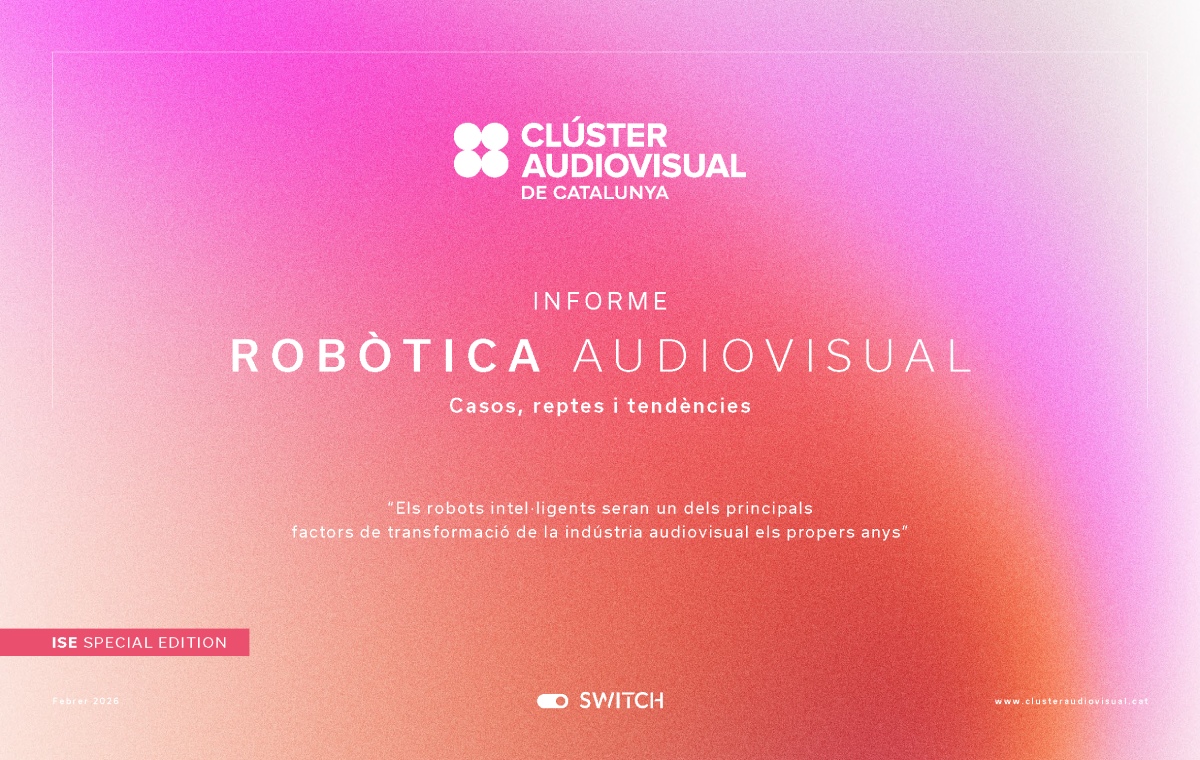
As part of the ISE 2026 program, three sessions on audiovisual robotics were organized, where the following report was presented:
- “How Audiovisual Robotics Are Transforming the AV Industry”, which featured a presentation by Joan Rosés; and a panel discussion with Natàlia Prats, Director of Digital and Technological Infrastructures at 3Cat; Joan Guasch, Director of International Development and R&D&I Policies at Eurecat; and moderated by Carlos Gómara, from the Department of Innovation and Technological Transformation at ACCIÓ.
- “Challenges and Trends of Drones in Audiovisual”, which featured Joan Rosés; Fran Arnau, CEO of Flock Drone Art Studio; Carlos Miguel Cortés, European Account Manager at Airmedia360; and moderated by Guillem González, journalist at Betevé.
- “Presentation of the First Audiovisual Robotics Report 2026 from the Audiovisual Cluster of Catalonia”, in the form of a presentation by Joan Rosés.
Strengthening Audiovisual Ecosystems with the Cases of Catalonia and the United Kingdom
The session “Strengthening audiovisual ecosystems in Catalonia and the United Kingdom” explored how public policy, industry, research, and innovation can align to generate long-term impact, using the United Kingdom and Catalonia as complementary case studies.
It began with a presentation by Will Saunders, Chief Creative Officer of the CoSTAR National Lab and Professor of Creative Industries at Royal Holloway University. He focused on the UK’s CoSTAR program: a nationally coordinated network of five R&D and advanced production labs, supported by £75 million of public investment and connected to major industry hubs such as MediaCityUK in Manchester, where innovation is scaled thanks to infrastructure like Dock10 and the BBC.
Will Saunders emphasized that “creative industries are enormously important for helping to grow not only economies but also for driving commercial and social value. What is happening here in Catalonia is incredible.”
In a subsequent roundtable discussion, Richard Wormwell, Head of Innovation at Dock10; Miquel Rutllant, President of the Audiovisual Cluster of Catalonia and a driving partner of Barcelona XRLAB; Marc López, Director of the Catalunya Media City project; Cristina Brandner, Manager of the Parc Audiovisual de Catalunya; and moderated by Joel Mestre, Creative Services EMEA at Disguise, joined the panel.
Richard Wormwell remarked: “I believe the vision proposed for Catalunya Media City is the right vision, and I can only wish them every success.”
The sessions “Bridging broadcast and cinema: virtual production across industries” and “Cinema, entertainment and advertising: virtual production in all formats” continued the discussion on LED virtual production and the multiple solutions it offers, from the perspective of Catalonia’s leading virtual production studios. Participants included Xavi Cánovas, General Manager of Driving Studios; Isaac Bergadà, Lead Manager of Virtual Grupo Mediapro; and Antoine Vaxelaire, co-founder of APPIA; with Cristina Brandner, manager of the Parc Audiovisual de Catalunya, moderating.

Two conferences dedicated to Artificial Intelligence were organized; the first, “Fundamentals of the Digital Image with Arturo Fuentes”, was a technical presentation on the inner workings of pixel-by-pixel generative AI. The second session, “AI and Gender Biases”, featured Cristina Mont, director of Lavinia AI, Helena Oller, head of strategy at Filmin, and was moderated by journalist Mariola Dinarès; it provided a space for reflection on how AI systems incorporate gender biases.
Other conferences organized by the Audiovisual Cluster on the main stages of the fair included:
- “New Professional Roles in Immersive Experiences” with Sourcing Unicorns, Flop Work, Barcelona XRLAB, and UNIVRSE.
- “Designing Architecture with AV Solutions in Mind” with Garcés – De Seta – Bonet Arquitectes, Marvel Architecture, Charcoalblue International, and Panasonic.
- “Transmedia IPs from Film to the Gaming World” with DeAPlanetaEntertainment, Open House Games, SelectaPlay, and ENTI-UB.
- “End-to-End Digital Signage” with EGMStudio and DCLED.
- “How Surgeons Are Using Audiovisual Technology to Transform Medicine” with Joan Moya of Ditec Group.
With a jury comprised of Patricia M. Val (Futura Space), Mònica Andreu (Eurecat), and Rita Giménez (Music Tech Hub and Escena 4.0), this year’s edition of the Audiovisual Cluster organized the “Young Talents and Technology” session, a University-Industry event held as part of Audiovisual Talent Week in November 2025. The following projects were presented: Cartografías invisibles (Invisible Cartographies) by Humbert Torrego; Fuga (Escape) by Laura Gili; Bath Life by Adrián Carro and Marco Berrocal; and Mans d’aprenent (Learning Hands) by Judit Puig. Link3rs, a member company of the Audiovisual Cluster, also presented its AI-powered simultaneous translation tool, developed by Hector Bordas.
Alongside the conferences, two luncheons were organized this year with the aim of establishing international connections. The first was a matchmaking breakfast between Catalonia and the United Kingdom, organized by ACCIÓ, the Catalan Audiovisual Cluster, and the British Consulate General in Barcelona. The second was a networking breakfast between Catalonia and Wallonia, organized by the Catalan Audiovisual Cluster, the TWIST Cluster, and Wallonia.be.
As in previous editions, the Audiovisual Cluster prepared two guided tours that took attendees to visit some of the main stands of the partner companies at the fair; and organized the “What’s new?” session, where about fifteen partner companies with stands in the Catalonia Pavilion, the Innovation Park or the Barcelona City Council, were able to present their projects and solutions.

The Catalan Audiovisual Cluster also participated in the “Cluster Collaboration Session,” part of the European Latin American AV Forum, which was moderated by Noemí Cuní, Vice President of the Catalan Audiovisual Cluster. They also collaborated on the workshop organized by the Futures of Communication Chair from Pompeu Fabra University.


 CR. EU. IN. HERITAGE: Cultural Heritage Innovation Grants
The Catalan Audiovisual Cluster, identifying agent of the most innovative trends at ISE 2026
The 2016 edition of ISE took place from February 3rd to 6th, closing with a record 92,170 visitors, an 8% increase over the previous edition, and 1,751 exhibitors.
Since the announcement in 2019 that the trade show would be held in Barcelona, the Catalan Audiovisual Cluster has acted as a connector between the event and the Catalan industry, creating opportunities to enhance the visibility of its member companies and the internationalization of the sector. Barcelona and Catalonia are positioning themselves internationally in the field of audiovisual technology thanks to the incorporation of new technologies into the solutions offered by Catalan companies.
Once again, the Catalan Audiovisual Cluster acted as a key identifier of the most innovative trends in the thematic areas of Audiovisual Robotics, Artificial Intelligence, Virtual Production, Immersive Experiences, Retail, and Emerging Talent.
It represented Catalan industry with 31 partner companies present at the fair, organized and participated in 23 activities and conferences, bringing 51 speakers, and collaborated in the organization of the ISE Tech Tours and in the dissemination of the ISE Open Innovation Challenge.
The Switch Observatory Presents the First Audiovisual Robotics Report
The Switch Observatory, an initiative of the Catalan Audiovisual Cluster dedicated to analyzing technological trends with a direct impact on the sector, presented its first Audiovisual Robotics Report. The document is available in Catalan and English.
The study analyzes the current state and trends of robotics applied to audiovisual production, with a clear focus on how these technologies are redefining image capture, virtual production, location shooting, and studio automation. With this analysis, the Catalan Audiovisual Cluster aims to contribute to anticipating changes, generating debate, and positioning the Catalan audiovisual ecosystem as an active player in building this new technological landscape.
Joan Rosés, editor of the Switch Observatory and author of the report, noted: “Robotics is no longer just a matter of efficiency. In audiovisual media, it is opening up new narrative possibilities: camera movements that were previously impossible, much more precise integration with virtual production, and adding ‘intelligence’ to physical devices.”
As part of the ISE 2026 program, three sessions on audiovisual robotics were organized, where the following report was presented:
Strengthening Audiovisual Ecosystems with the Cases of Catalonia and the United Kingdom
The session “Strengthening audiovisual ecosystems in Catalonia and the United Kingdom” explored how public policy, industry, research, and innovation can align to generate long-term impact, using the United Kingdom and Catalonia as complementary case studies.
It began with a presentation by Will Saunders, Chief Creative Officer of the CoSTAR National Lab and Professor of Creative Industries at Royal Holloway University. He focused on the UK’s CoSTAR program: a nationally coordinated network of five R&D and advanced production labs, supported by £75 million of public investment and connected to major industry hubs such as MediaCityUK in Manchester, where innovation is scaled thanks to infrastructure like Dock10 and the BBC.
Will Saunders emphasized that “creative industries are enormously important for helping to grow not only economies but also for driving commercial and social value. What is happening here in Catalonia is incredible.”
In a subsequent roundtable discussion, Richard Wormwell, Head of Innovation at Dock10; Miquel Rutllant, President of the Audiovisual Cluster of Catalonia and a driving partner of Barcelona XRLAB; Marc López, Director of the Catalunya Media City project; Cristina Brandner, Manager of the Parc Audiovisual de Catalunya; and moderated by Joel Mestre, Creative Services EMEA at Disguise, joined the panel.
Richard Wormwell remarked: “I believe the vision proposed for Catalunya Media City is the right vision, and I can only wish them every success.”
The sessions “Bridging broadcast and cinema: virtual production across industries” and “Cinema, entertainment and advertising: virtual production in all formats” continued the discussion on LED virtual production and the multiple solutions it offers, from the perspective of Catalonia’s leading virtual production studios. Participants included Xavi Cánovas, General Manager of Driving Studios; Isaac Bergadà, Lead Manager of Virtual Grupo Mediapro; and Antoine Vaxelaire, co-founder of APPIA; with Cristina Brandner, manager of the Parc Audiovisual de Catalunya, moderating.
Two conferences dedicated to Artificial Intelligence were organized; the first, “Fundamentals of the Digital Image with Arturo Fuentes”, was a technical presentation on the inner workings of pixel-by-pixel generative AI. The second session, “AI and Gender Biases”, featured Cristina Mont, director of Lavinia AI, Helena Oller, head of strategy at Filmin, and was moderated by journalist Mariola Dinarès; it provided a space for reflection on how AI systems incorporate gender biases.
Other conferences organized by the Audiovisual Cluster on the main stages of the fair included:
With a jury comprised of Patricia M. Val (Futura Space), Mònica Andreu (Eurecat), and Rita Giménez (Music Tech Hub and Escena 4.0), this year’s edition of the Audiovisual Cluster organized the “Young Talents and Technology” session, a University-Industry event held as part of Audiovisual Talent Week in November 2025. The following projects were presented: Cartografías invisibles (Invisible Cartographies) by Humbert Torrego; Fuga (Escape) by Laura Gili; Bath Life by Adrián Carro and Marco Berrocal; and Mans d’aprenent (Learning Hands) by Judit Puig. Link3rs, a member company of the Audiovisual Cluster, also presented its AI-powered simultaneous translation tool, developed by Hector Bordas.
Alongside the conferences, two luncheons were organized this year with the aim of establishing international connections. The first was a matchmaking breakfast between Catalonia and the United Kingdom, organized by ACCIÓ, the Catalan Audiovisual Cluster, and the British Consulate General in Barcelona. The second was a networking breakfast between Catalonia and Wallonia, organized by the Catalan Audiovisual Cluster, the TWIST Cluster, and Wallonia.be.
As in previous editions, the Audiovisual Cluster prepared two guided tours that took attendees to visit some of the main stands of the partner companies at the fair; and organized the “What’s new?” session, where about fifteen partner companies with stands in the Catalonia Pavilion, the Innovation Park or the Barcelona City Council, were able to present their projects and solutions.
The Catalan Audiovisual Cluster also participated in the “Cluster Collaboration Session,” part of the European Latin American AV Forum, which was moderated by Noemí Cuní, Vice President of the Catalan Audiovisual Cluster. They also collaborated on the workshop organized by the Futures of Communication Chair from Pompeu Fabra University.